


In a recent blog post, we saw that the Atlanta Metropolitan Statistical Area (MSA) has followed the nationwide trend of slowed population growth, but that it nevertheless grew faster than the nation as a whole. Another recent post showed that while Fulton and Gwinnett counties had the greatest population increases in raw numbers, the highest percentage growth was taking place at the periphery of the region. The Census Bureau has recently released new city population estimates, which will allow us to dig down to a more granular level. Which cities grew the fastest in the last year? Have any cities in the Atlanta MSA lost population? How does the picture look if we examine the last five years instead?
To answer these questions, we will utilize the newly released 2025 Vintage City and Town Population Estimates. In this release, the Census Bureau provides estimates for each city as of July 1 each year 2020 through 2025. It does so holding constant each city’s boundaries at those in effect as of January 1, 2025. In so doing, the Census Bureau provides historical estimates back to 2020 for the areas that make up the new cities of Mableton and Mulberry, even though they did not exist at that time.
The Atlanta MSA contains 149 cities[1] within its 29 counties– too numerous to place in a single graph. Figure 1 therefore presents the 20 fastest growing cities and towns in the Atlanta MSA between 2024 and 2025 on a percentage basis. The reference line denotes the growth of the MSA during the same period.
Figure 1: Population Change in the 20 Fastest Growing Cities in the Atlanta MSA, July 1, 2024 – June 30, 2025
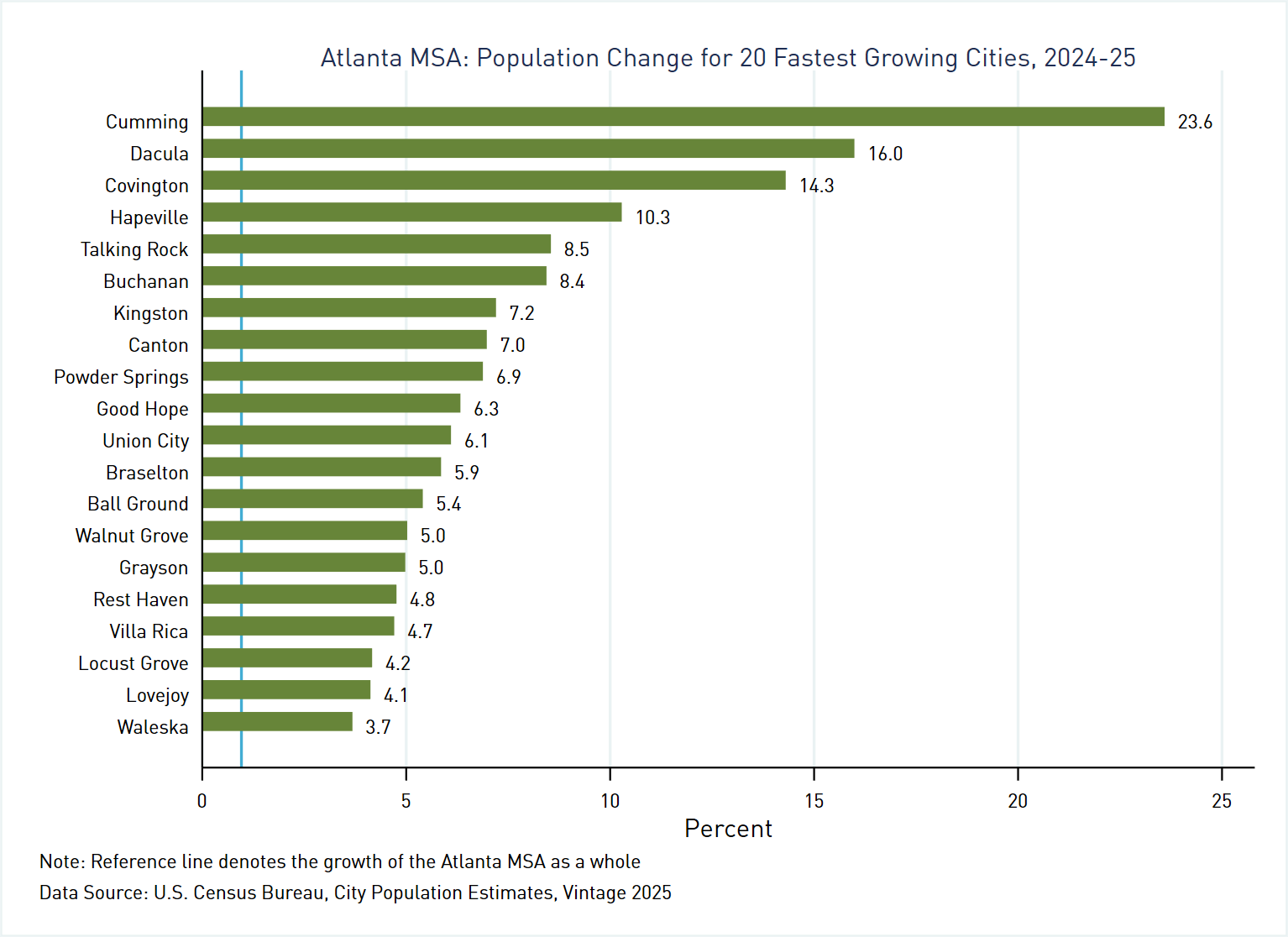
This graph shows that the city of Cumming in Forsyth County grew an astonishing 23.6% between 2024 and 2025 according to Census Bureau estimates. Dacula (16.0%), Covington (14.3%), and Hapeville (10.3%) all posted growth of over 10% in a single year.
The cities making up the top 20 in terms of growth are all in the small- to medium-sized range: the largest city in this group is Canton, with an estimated population of 40,778 on July 1, 2025, followed by Union City (29,910), Villa Rica (21,022), and Powder Springs (21,004). All other cities in the top 20 had fewer than 20,000 residents, including the four cities mentioned above as having enjoyed 10% or greater growth: Cumming (12,494), Dacula (9,373), Covington (17,477), and Hapeville (7,410).
What of the larger cities in the region? Figure 2 presents population change for the top 20 cities. Cities in this graph are sorted in descending order according to baseline 2024 population estimates; the reference line again denotes the growth of the MSA.
Figure 2: Population Change in the 20 Largest Cities in the Atlanta MSA, July 1, 2024 – June 30, 2025
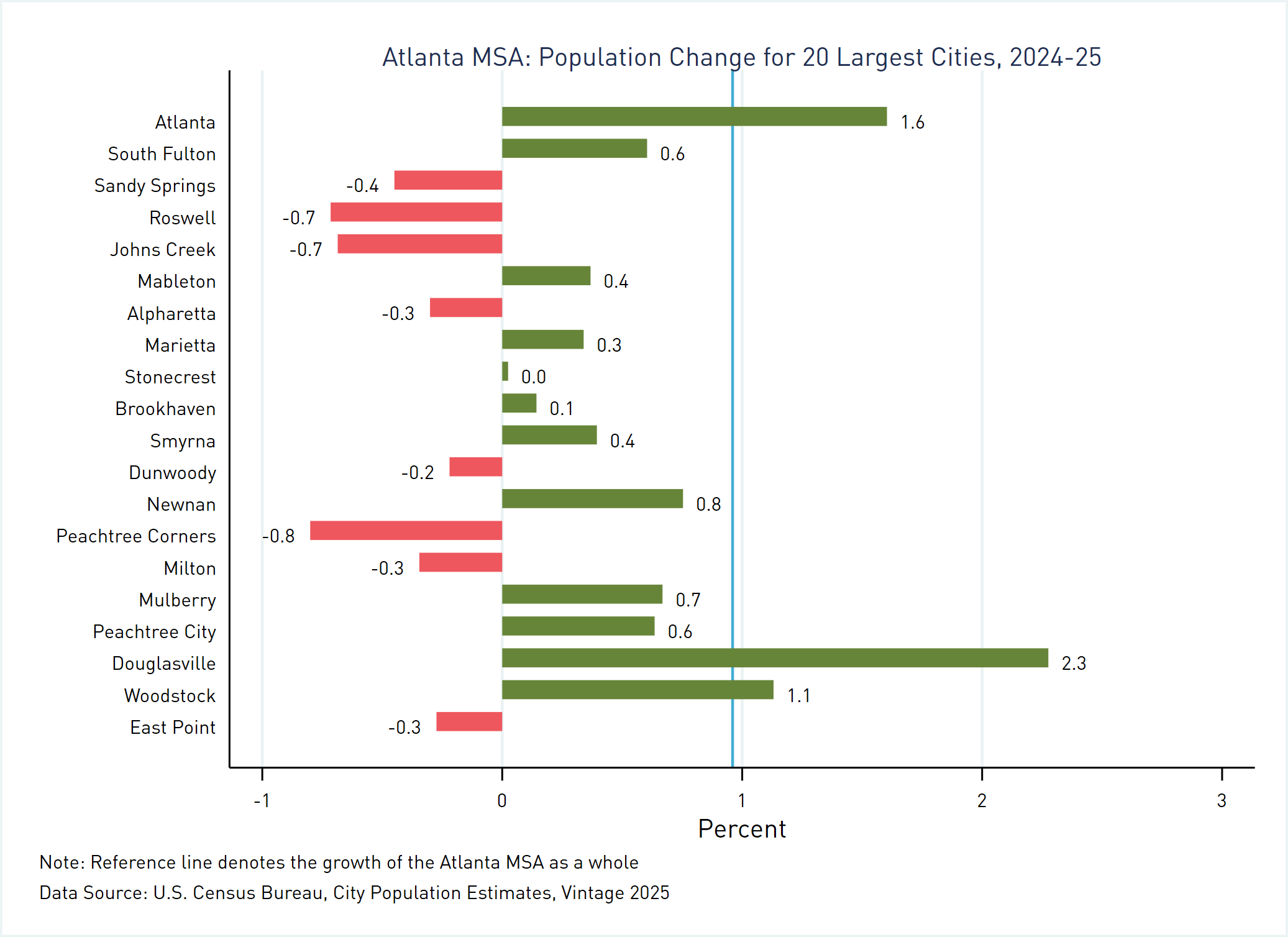
As seen in this graph, only three of the larger cities within the Atlanta MSA grew faster than the region as a whole: Atlanta (an increase of 8,350 people or 1.6%), Douglasville (924 people, or 2.3%), and Woodstock (446 people, or 1.1%). By contrast, eight of the 20 largest cities lost population, though the decreases were generally small– none lost more than 1% of its 2024 population.
Figure 3 shows how these patterns play out spatially. Red depicts cities that have lost population, while gray denotes cities that grew more slowly than the region. Cities in the various shades of green grew faster than the region as a whole. Note that areas in white are unincorporated territory not part of any city.
Figure 3: Population Change for Cities in and near the Atlanta MSA, July 1, 2024 – June 30, 2025
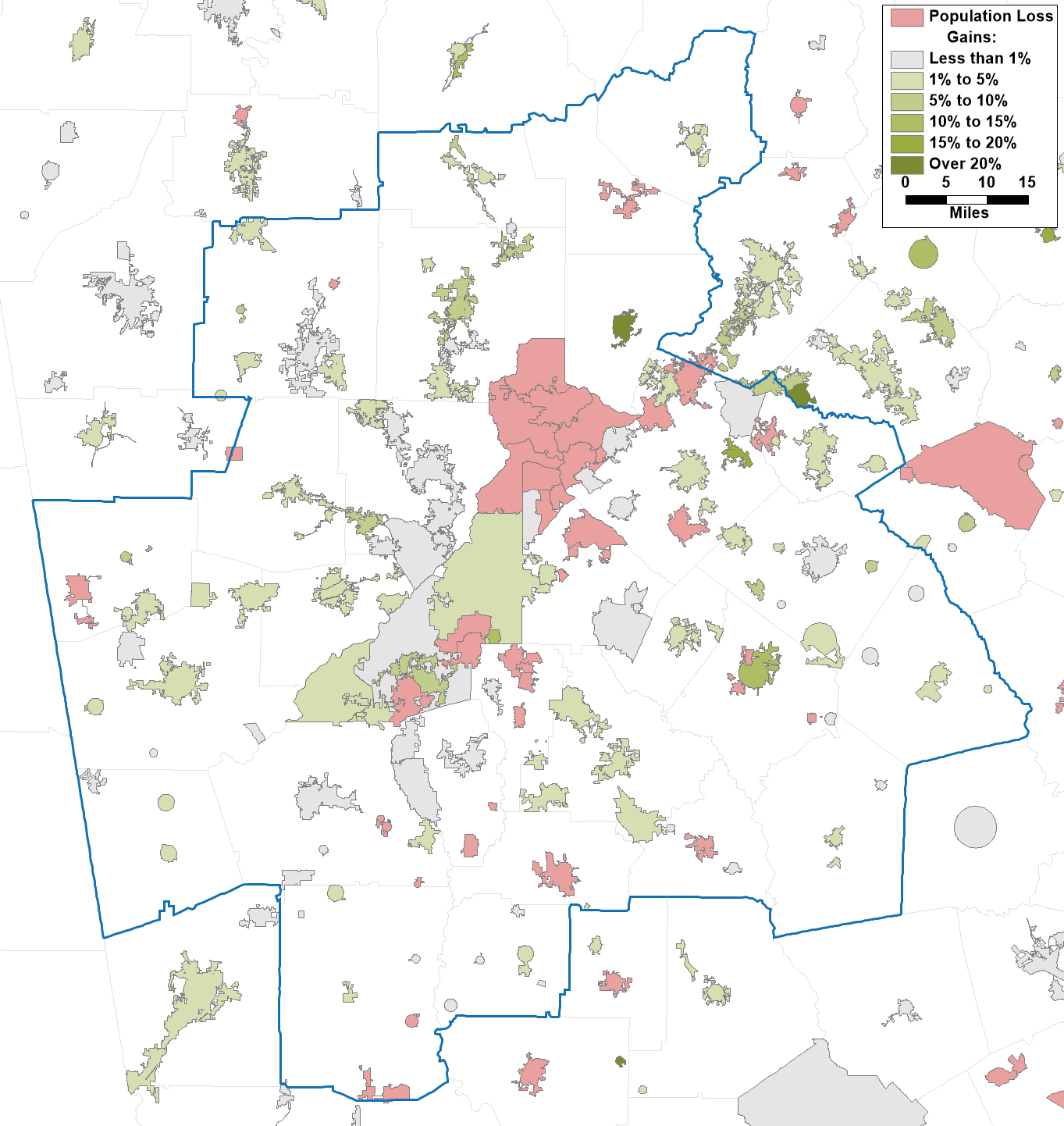
Data Source: U.S. Census Bureau, Vintage 2025 City and Town Population Estimates
We see in this map that many of the cities that lost population are in clusters. All of the cities in Fulton County north of Atlanta shed some population, as did a contiguous group crossing into DeKalb (Dunwoody, Chamblee, and Doraville) and Gwinnett (Peachtree Corners, Berkeley Lake, and Suwanee). Tucker and Clarkston declined in population, as did their close (but not contiguous) neighbors Stone Mountain and Pine Lake. In Clayton County, the contiguous trio of Forest Park, Lake City, and Morrow all lost population, as did the duo of East Point and College Park in south Fulton County. With the exception of Hapeville, the fastest growing cities are all at the periphery. Hoschton, the fastest growing city in the state (gained 1,869 people or 28% of its 2024 population) is just outside the MSA on the Jackson County side of the border with Barrow County. The City of Atlanta posted the highest growth in the state– and 11th most in the nation– in absolute terms[2]– and outpaced the MSA on a percentage growth basis.
As we often note, it is best not to make too much of a single year’s data. What if we take a step back and look at a five-year period? Figure 4 presents change from July 1, 2020 through June 30, 2025.
Figure 4: Population Change for Cities in and near the Atlanta MSA, July 1, 2020 – June 30, 2025
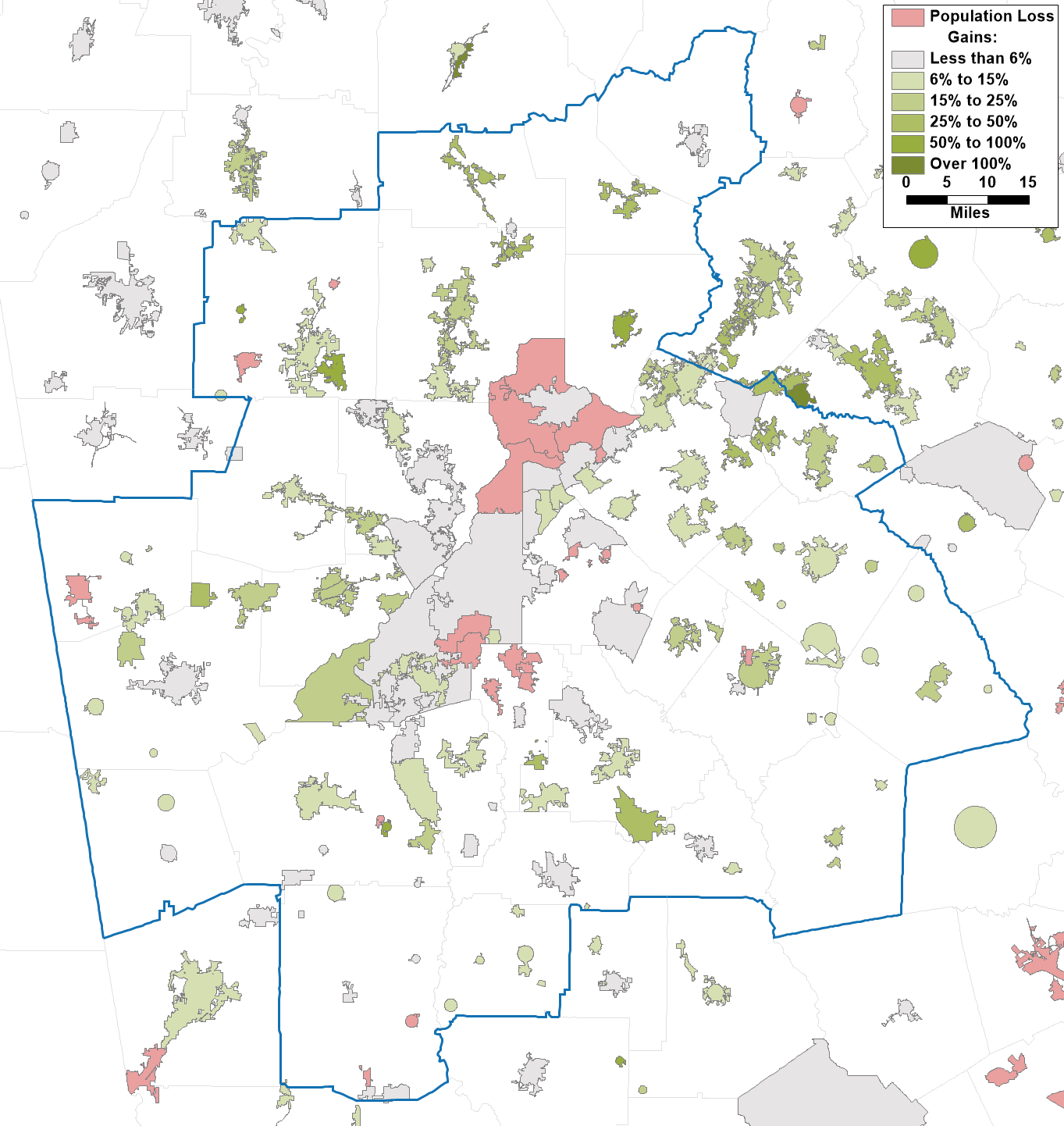
Data Source: U.S. Census Bureau, Vintage 2025 City and Town Population Estimates
This map shows a pattern closer to the county-level trend observed in the previous post[link]: slower growth (or, at the city level, population losses) at the center, more rapid growth at the periphery. Some cities such as Alpharetta, Dunwoody, Chamblee, Doraville, and Fairburn that lost population between 2024 and 2025 actually grew modestly during the five-year period. The city of Hoschton grew nearly 211% during these five years, again claiming the highest percentage population growth.
The City of Atlanta grew 5.8%, adding 29,024 residents– more than the current population of Decatur. This growth rate puts it almost perfectly in line with the region as a whole, which grew 5.9% over this same period. Atlanta thus stands in contrast to most of its immediate neighbors. We’ll take a closer look at growth of our central city in the next post.
Notes:
[1] This count includes seven cities that straddle the MSA boundary: Braselton, Braswell, Buford, Manchester, Pine Mountain, Rest Haven, and Taylorsville.
[2] See https://www.census.gov/newsroom/press-releases/2026/vintage-2025-city-town-pop-estimates.html