


In a recent blog post, we saw that as of last year, about two-thirds of households in the Atlanta Metropolitan Statistical Area used artificial intelligence (AI) tools. This put Atlanta near the median among the ten most populous metropolitan areas and well above the nation as a whole. How do Atlanta’s AI users perceive artificial intelligence?
To answer this question, we return to the Census Bureau’s June 2025 Household Trends and Outlook Pulse Survey (HTOPS).[1] This survey presented AI users[2] with a series of statements and asked them to indicate which of these statements they agreed with. Figure 1 presents the results for AI users residing in the Atlanta MSA:
Figure 1: Beliefs about Artificial Intelligence among Atlanta AI Users
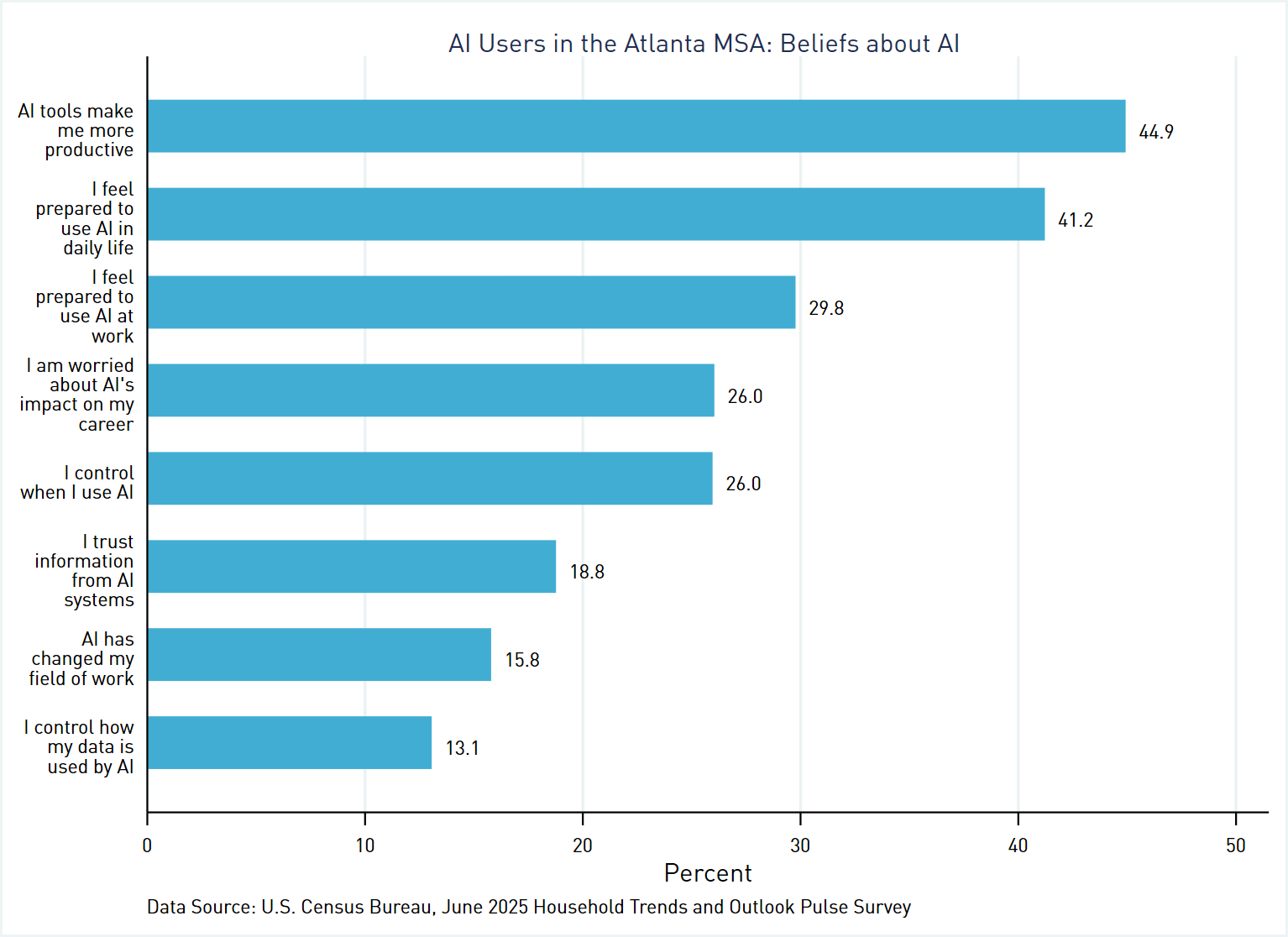
As this graph shows, metro Atlanta AI users are somewhat skeptical about AI. Less than half of respondents (44.9%) agree that AI tools make them more productive; only about one in five (18.8%) trust information from AI systems; and only one in eight (13.1%) feel they are in control of how their data are used.
Less than one in five Atlantans (15.8%) who use AI agree that AI has changed their field of work. Interestingly, this skepticism seems to breed a level of hope about the demand for their own skills. Only about one quarter (26.0%) are worried about AI’s impact on their careers.
How do these perceptions stack up against other major metros?
Figure 2 presents the percentage of AI users who agree that it has made them more productive by metro area; the reference line marks the nationwide total, including respondents residing outside of the top metros.
Figure 2: Top 10 Metros: Agreement among AI users that Artificial Intelligence has Made them More Productive
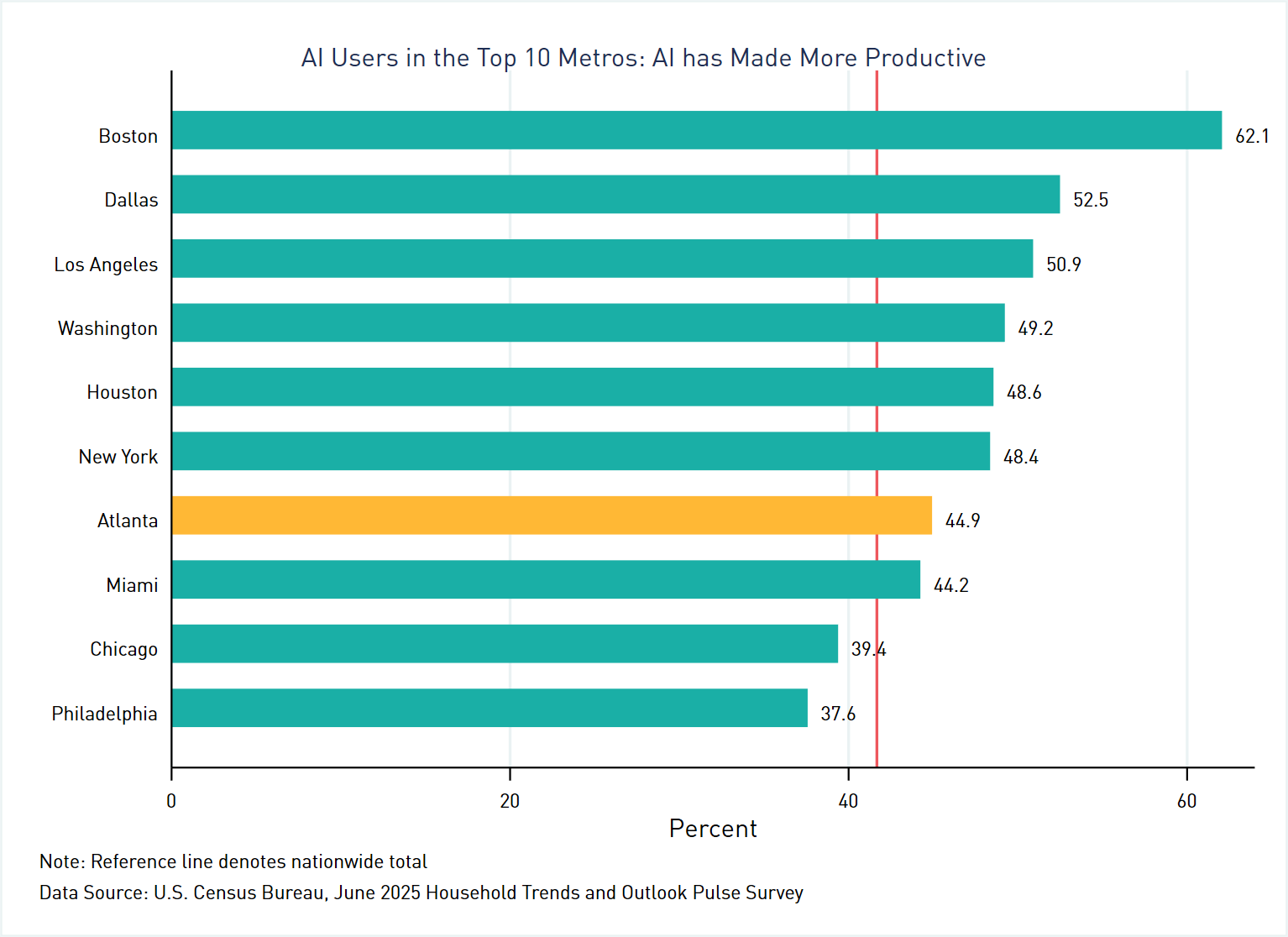
There is considerable variation among AI users in different metros on this question. Majorities of respondents in Boston (62.1%), Dallas (52.5%), and Los Angeles (50.9%) agree that AI has made them more productive. Chicago AI users (39.4%) are closest in attitudes to the nation as a whole (41.7%), while Philadelphia AI users (37.6%) are the least likely to agree that AI has made them more productive.
Figure 3 displays the percentage of AI users who are concerned that AI will impact their careers. Again, the reference line denotes the nationwide total.
Figure 3: Top 10 Metros: Concerns among AI users that Artificial Intelligence will Impact their Careers
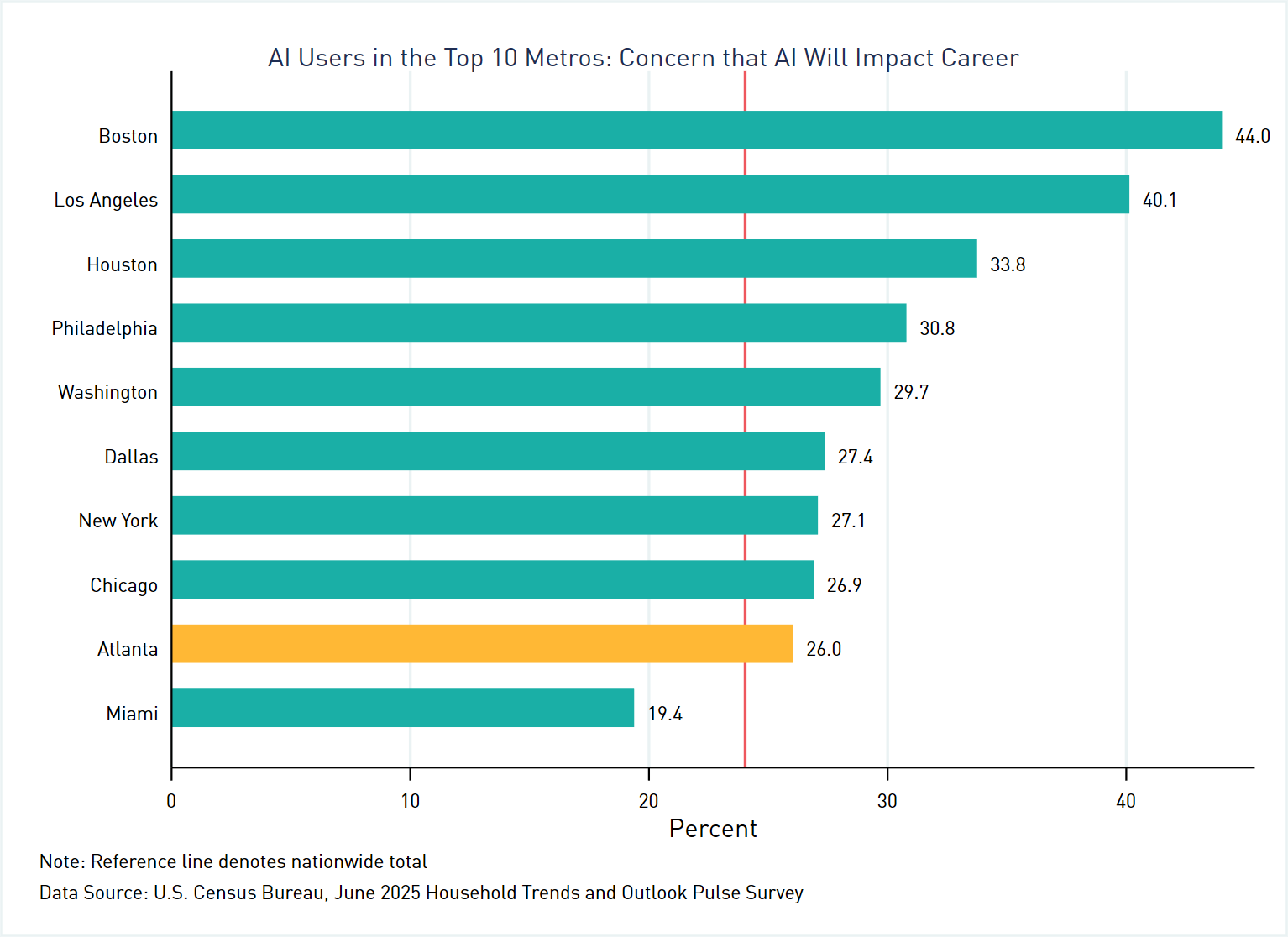
Boston (44.0% agree) and Los Angeles (40.1%) AI users are the most likely to fear for their jobs. These represent two of the three metros where a majority agree that AI makes them more productive. But Dallas, the third metro in that group, is close to the median metro area on this question. Only 27.4% of Dallas AI users are concerned about career impacts. Atlanta AI users (26.0%) are most in line with AI users nationwide (24.0%) in having AI related career concerns, while Miami AI users (19.4%) are the least concerned.
Figure 4 shows the percentage of AI users who trust information from AI systems, with a reference line for the nationwide figure.
Figure 4: Top 10 Metros: Trust of information from AI Systems among Artificial Intelligence Users
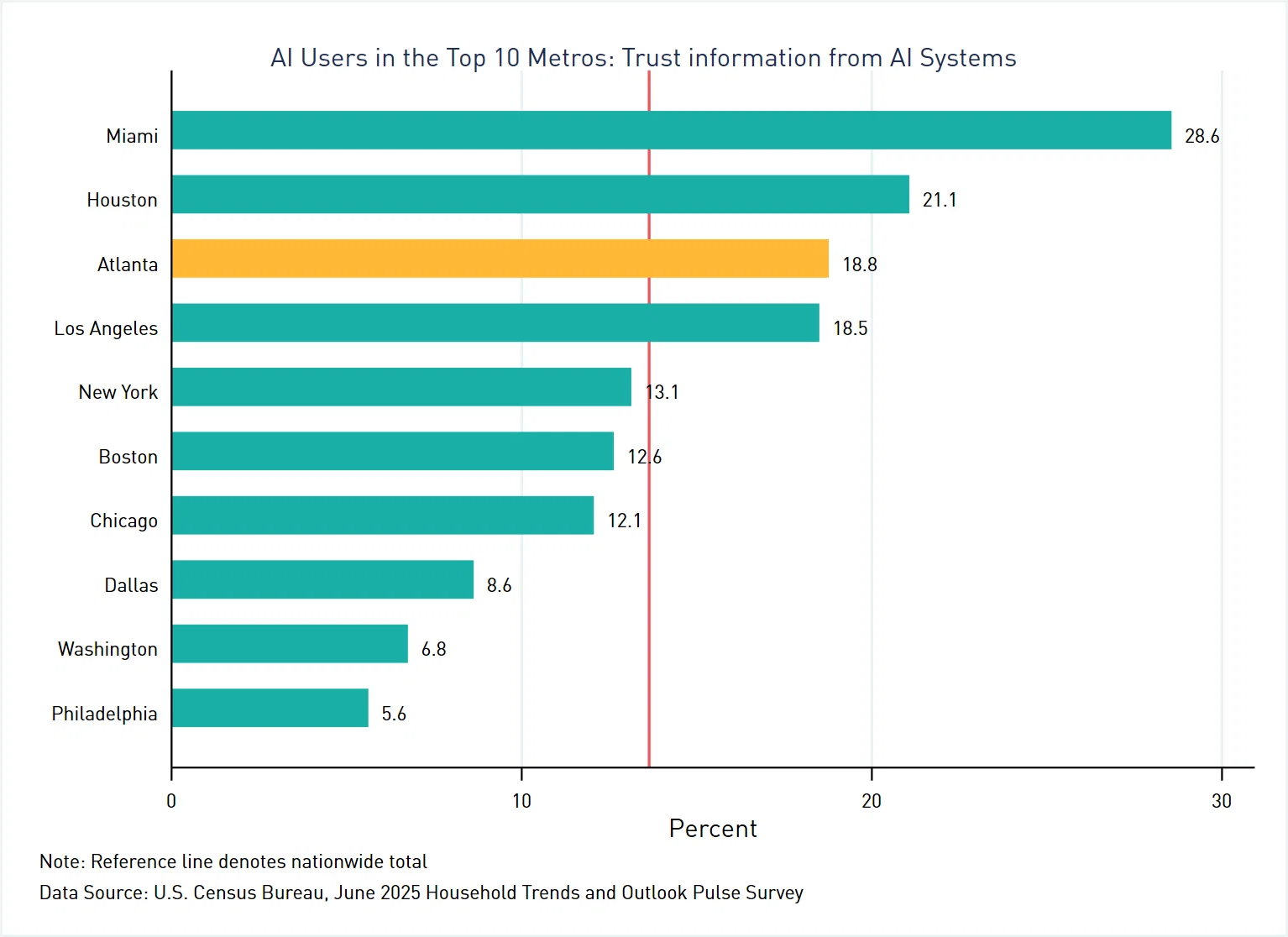
Less than one third of AI users from any metro area regard AI systems as trustworthy. Miami AI users– the least likely to express career concerns and among the bottom three agreeing that AI makes them more productive are the most likely to trust information from AI systems (28.6%). New York (13.1%) is the metro area closest to the national average of 13.6%, while Washington and Philadelphia are the most skeptical of AI trustworthiness.
In the end, AI– like any emerging technology– has the capacity to help or harm. We expect that use of (and attitudes toward) AI will evolve along with the technology itself. If the HTOPS repeats the AI question battery in the future, we will report back on how those have changed.
Want to explore further? The sample size of the HTOPS does not allow us to dig into differences by demographics within Atlanta. But the Census Bureau published tables that compare responses by demographic characteristics for the nationwide sample.
Notes:
[1] The HTOPS is a nationally-representative survey that explores some topics longitudinally, while also allowing opportunities for exploration of emerging issues. The HTOPS microdata allow us to analyze results for the nation as a whole, as well as for the ten most populous metro areas. The results discussed in this post are from data collected June 16-25, 2025.
[2] Respondents who reported that someone in their household had utilized AI for at least one of a list of use cases in the prior two months; see the previous post for more details.