


Artificial Intelligence is transforming daily life for millions of Americans. How widespread is the use of AI tools in the Atlanta Metropolitan Statistical Area (MSA), and how does that compare to other top metros and the nation as a whole? What use cases are Atlantans finding for AI?
We can get leverage on these questions with a new experimental dataset from the Census Bureau, the Household Trends and Outlook Pulse Survey (HTOPS). The HTOPS is a nationally-representative survey that explores some topics longitudinally, while also allowing opportunities for exploration of emerging issues. The HTOPS microdata allow us to analyze results for the nation as a whole, as well as for the ten most populous metro areas.[1] The most recent release is for data collected June 16-25, 2025; the AI questions were new for this survey round.
The survey [2] presented a series of eight use cases [3] for AI and asked whether anyone in the household had used AI for each of these purposes in the last two months. Figure 1 shows the percentage of respondents who reported AI use in their households for at least one of these eight activities. The reference line marks the nationwide percentage, including respondents who reside outside the ten largest metros.
Figure 1: Percentage of Households Using of AI Tools in the Last Two Months (June 2025)
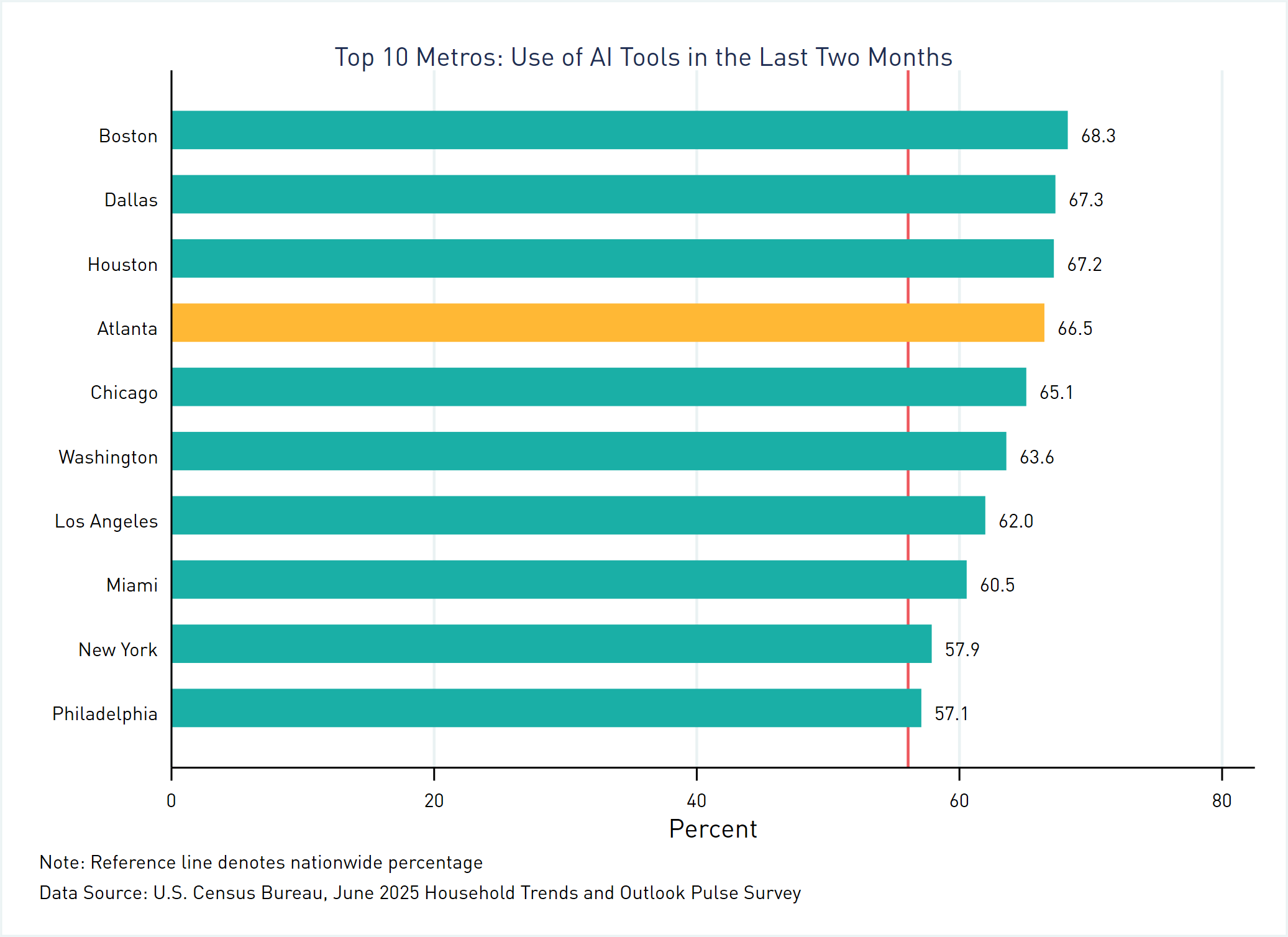
This graph shows that a majority of American households (56.1%) used AI tools for at least one purpose in the two months preceding the survey. Given that fiber and other infrastructure needed for high-speed Internet is more concentrated in urbanized areas, it is no surprise that AI utilization rates were higher in all top 10 metros than the nationwide total. There is also considerable variation in utilization among the top ten metros: Boston households were the most likely to have used AI tools, while New York and Philadelphia brought up the rear. Atlanta falls close to the median among metro areas, with 66.5% of households using AI tools.
How do residents of the Atlanta MSA use AI tools? Figure 2 reports the percentage of respondents whose households utilized AI by specific application:
Figure 2: Percentage of Metro Atlanta Households Using AI Tools in the Last Two Months by Type (June 2025)
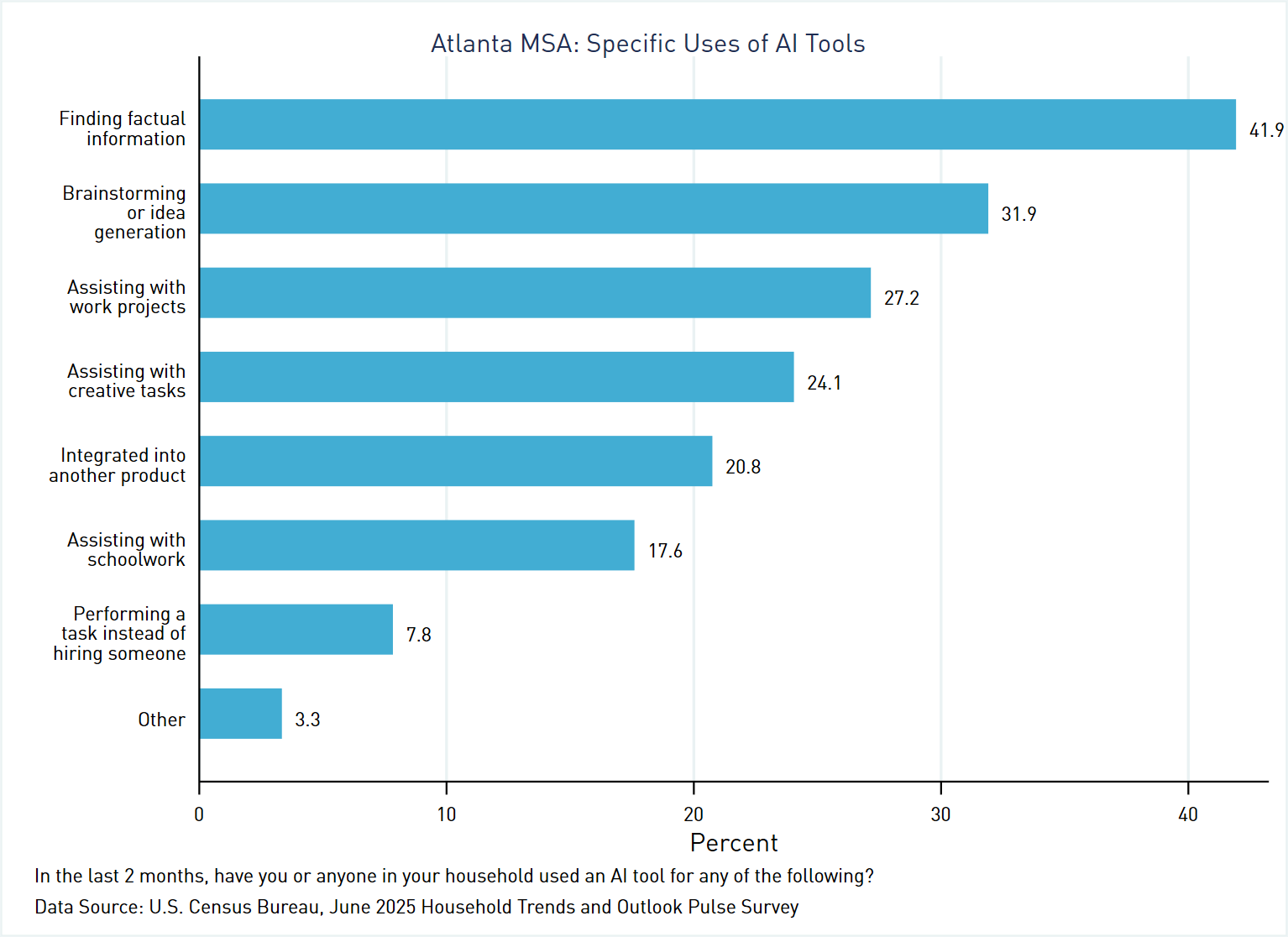
We see that the most common uses for AI tools are finding factual information (41.9%) and brainstorming (31.9%). Just over one-quarter of respondents (27.2%) report that someone in the household used AI for help with a work project and just under one quarter (24.1%) report assistance with creative tasks. The use most associated with agentic AI– using AI to perform a task instead of hiring a person– is fairly low (7.8%). The rank ordering of use cases is the same nationwide as for the Atlanta MSA, only utilization is lower, consistent with the lower national percentage of households that use AI mentioned above.
How do Atlantans who use AI feel about these tools, and how do their attitudes compare to AI users in other top metros? We’ll explore those questions in a forthcoming post.
Notes:
[1] Compared to the Current Population Survey (~60,000/month) and American Community Survey (~290,000/month) the HTOPS has a very small sampling frame– just 7,485 respondents in the June 2025 microdata release. The lower cost associated with the small size allows this survey to be nimble, making it an excellent test bed for new questions. But even with oversampling of the top ten metros, the Atlanta MSA sample numbered only 331 respondents. That is enough to compare Atlanta with the other major metros, but not enough for us to dig into demographics within the Atlanta sample.
[2] The actual question wording was: “Artificial Intelligence (AI) refers to computer systems that perform tasks requiring human intelligence, such as decision-making, language processing, and image recognition. Examples include virtual assistants, online translation tools, and generative AI (e.g., ChatGPT, Gemini, or Claude), which can create text or images. In the last 2 months, have you or anyone in your household used an AI tool for any of the following? Select all that apply.”
[3] The choices offered were as follows: Finding factual information; Assisting with schoolwork; Assisting with work projects; Performing a task you would have otherwise hired someone to do; Assisting with creative tasks (e.g., writing, drawing); Brainstorming or idea generation; Integrated into another product you use (e.g., search engine, app); and Other (please specify).